Products – Plastics welding machines
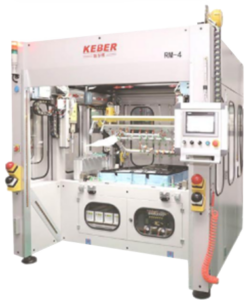
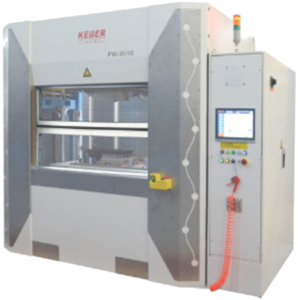
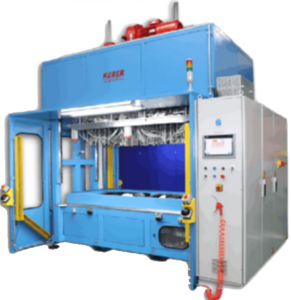
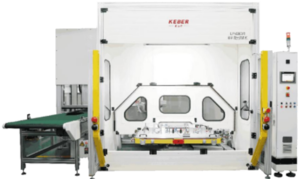
For any plastic welding and/or joining process, KEBER has the solution .
The plastic welding machinery provided by the company is applicable to a wide variety of products in the industries of automotive parts manufacturing, lighting, electrical and electronic applications, toys, pallets, among others.
With these solutions, KEBER supports its customers with professional, timely and high quality service, before, during and after the sale; in addition, it offers personalized technical advice and customized equipment to the customer's needs, with the purpose of consolidating and offering an integral product in America.

Ultrasonic
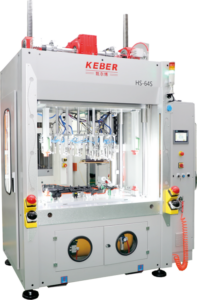
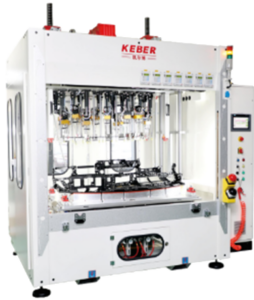
It is a mechanism where an ultrasonic wave is generated and transmitted by sonotrodes, which vary the shape of their point of contact with the material according to the requirements of each product. The wave heats the surface and binds by exerting a predetermined pressure and results in a molecular bond between the parts. It is highly energy efficient, with no need for fixtures or consumables. Ultrasonic welding machines create powerful, high-frequency vibrations that are applied locally and its speed, efficiency, non-contamination and strong, tight joints make this technique a popular choice in a variety of industrial applications.

Vibration or friction linear
It consists in the friction of the surfaces to be welded and by means of the heat generated the plastic material softens and when pressure is exerted to join the surfaces, they are welded when they cool down. It is ideal for joining large plastic parts, intricate areas, multi-plane objects and curved surfaces of different shapes, and is a common technology in automotive, appliance production and other industries.

Hot Plate
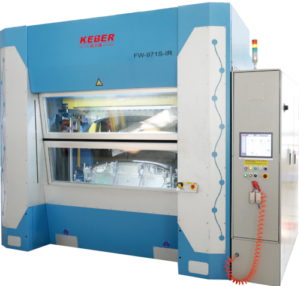
Hot plate welding is mainly done by controlling the temperature of the hot plate (by electric heating and infrared heating), to achieve the plasticity of the workpiece welding between two workpieces is the hot plate, when the workpiece is near or in contact with the heating plate, the plastic begins to melt and when it reaches a certain degree of melting the heating plate comes out and then the two workpieces are joined and welded together, then the workpieces are cooled curing and finishing the whole welding process. Plastic hot plate welding joins two or more complex geometric shapes, curved surfaces or internal walls. Available in horizontal and vertical orientations.

Infrared tubes
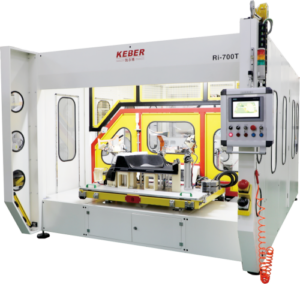
The heat welding method in which there is no contact between the participating elements during the process. The parts to be joined are positioned very close to the tubes and by induction, the parts to be welded are heated and, when the tubes are removed, the pressure and cooling phase begins, obtaining the weld. Customized infrared offers clean joining solutions for similar and dissimilar materials, ideal for delicate parts. Very precise process control offers more flexibility to incorporate aesthetically pleasing welds into complex product designs, providing greater range and part variability. Particle-free welding with a contact-free process for improved part quality and aesthetics.

Vacuum welding
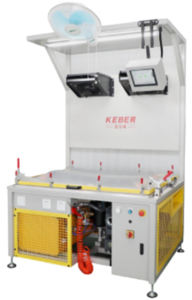
It is performed by means of a plastic membrane with suction equipment. The product to be processed is covered by the plastic membrane and, by means of air suction and heating equipment, the coating material is uniformly adhered to the plastic part. In our vacuum system, the parts are loaded into a large double-space rotating aluminum chamber fed by banks of electric heating elements. Unlike other technologies, a vacuum braze heats the entire part and not just the joint area. Brazing or heat treating in a high vacuum environment offers a high degree of process control and produces exceptionally clean parts, free of oxidation and material scaling. With induction heating, it is possible to specifically design the current flow that is induced into the part or susceptor (hot zone), precisely controlling the heat pattern and thus the amount and area of heat. Cycle times are greatly reduced and parts can be quickly processed individually or in small quantities as required.
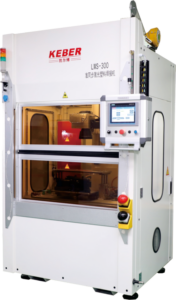
Hot spot welding
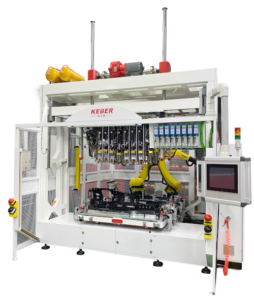
The machine uses single-point temperature control, and each welding spot can be adjusted independently (front, rear, right, and left). Equipped with a wind power system and rapid cooling, it improves production efficiency and welding accuracy. It is a method of joining components that uses a molded stud or protrusion to mechanically retain the mated component. Heat is applied to the protrusion, softening it. A forming tool is then used to reshape the material into a cap or stud. The process offers numerous advantages. It is fast and cost-effective, eliminates the use of fasteners, and allows for joining dissimilar materials. Applications range from hot-riveted plastic reinforcements for vehicle door panel assembly to bonding PCBs to plastic housings. The benefits of this technique include no vibration damage, no particulate, the ability to rivet metal-coated applications, and the ability to rivet in difficult or restricted access areas.